Well, I managed to do what I did not think that I could do this long weekend. I assembled both sides of the crib. When you consider that my wife and I also attended a wedding ceremony on Saturday morning and a wedding reception on Saturday evening I am surprised that I finished both sides.
I thought that it was difficult cutting 56 mortises and 56 tenons. It was, but the difficulty was in the shear quantity of work. It was more a matter of repetition. Assembling 28 tenons into 28 mortises is yet another story. I have assembled mortises and tenons before but it was usually assembling a frame or assembling legs into a table or chair. Assembly all 28 verticals into the top and bottom took some thought and a lot of coordination, both physical and mental. One of the problems was that you have to work quickly. From the time you glue the first mortise and tenon until the glue the last mortise and tenon the glue of the first set must still be wet so that you push everything together for assembly.
Following my wife's suggestion I poured some glue into a little container then used a wide artist's brush to apply the glue. The brush allowed me to deliver the glue quickly and accurately without wasting glue of applying it where I did not want it. That method helped a lot. As you can see in the picture I used my table saw as a work surface. Of course it was unplugged and the blade was out of the way. I cover the top of the table saw with a sheet of plywood and covered the plywood with newspaper then I propped the frame up on pieces of 2X4. I put glue into the bottom rail then applied glue to each tenon of each vertical as I inserted it into the mortise. Then I applied glue to the top rail, applied glue to the tenons on top then assembled everything together. The trick is to get all the tenons and all the mortises lined up. Once you get to the point of lining everything up it is simply a matter of applying the clamps and tightening everything down. I glued one wide on Saturday between going the wedding ceremony and the wedding reception. I glued the second side today after dinner.
I would say that I have broken the elephant's back. the biggest parts of the project are done. Now it is trimming, rounding all the edges, drilling holes for assembly and painting.
The worst is behind me!
Monday, September 5, 2011
Thursday, September 1, 2011
A BABY'S CRIB - PART SIX
I wrote about making the two ends of the crib which consisted of the posts, a top rail, a bottom rail and the panel that is enclosed in the frame. I realize now that making the ends of the crib was the easiest part of the project.
The second part of the project is to create the sides of the crib. Both sides are open. I designed them according to CSA requirements. The vertical pieces are 1 1/2 inches wide and 3/4 of an thick. They are spaced 2 inches apart. Actually, CSA allow the verticals to be about 2 1/3 inches apart. It was easier to space them 2 inches apart.
The issue was how to secure the verticals to the top and bottom rail so that it was strong and would take lots of abuse from an active, growing baby. All things considered, I decided that mortise and tenon joinery would be the strongest joint for this construction. I had no idea what I was getting myself into. Design the joint was easy. I used the 'thirds' rule with common sense. The tenons were 1/4 of an inch thick and 1/2 an inch wide. The mortises were obviously the opposite dimensions in the rails to accept the tenons.
On paper, it looks completely doable in a short period of time. In reality, it took a lot longer than I thought it would. I have completed the process of cutting the tenons and the mortises. When I look back it was quite a task cutting 56 tenons and 56 mortises. Even though I already have a tenoning jig that I had built myself several years ago it took me and entire weekend to cut 56 tenons.
Now the mortises were an entirely different story. If I had a mortising fixture it would be a relatively easy job. But I do not have a mortising fixture, they are expensive and I do not cut mortises every day so I cannot justify the cost. Second choice would be to use my router on a router table. This would be a great idea but I do not have a router table. It is on my list of things that I am going to build for my work shop...right after I finish making this crib! The only logical choice was to come up with a temporary set up that I could use to cut the mortises and then take it down when I was finished which is exactly what I did. the setup worked well enough. It required a steady hand and a lot of good hand-eye co-ordination but I got all of the mortises done as well.
Now I am ready to start fitting and gluing the verticals to the top and bottom rails.
The second part of the project is to create the sides of the crib. Both sides are open. I designed them according to CSA requirements. The vertical pieces are 1 1/2 inches wide and 3/4 of an thick. They are spaced 2 inches apart. Actually, CSA allow the verticals to be about 2 1/3 inches apart. It was easier to space them 2 inches apart.
The issue was how to secure the verticals to the top and bottom rail so that it was strong and would take lots of abuse from an active, growing baby. All things considered, I decided that mortise and tenon joinery would be the strongest joint for this construction. I had no idea what I was getting myself into. Design the joint was easy. I used the 'thirds' rule with common sense. The tenons were 1/4 of an inch thick and 1/2 an inch wide. The mortises were obviously the opposite dimensions in the rails to accept the tenons.
On paper, it looks completely doable in a short period of time. In reality, it took a lot longer than I thought it would. I have completed the process of cutting the tenons and the mortises. When I look back it was quite a task cutting 56 tenons and 56 mortises. Even though I already have a tenoning jig that I had built myself several years ago it took me and entire weekend to cut 56 tenons.
| The tenoning jig works great. It holds the piece straight and tight. The problem was that the maple was so hard that I had to take small cuts or else it would burn the wood which it did anyway. |
| In the end, I had 56 precision cut tenons. |
Now the mortises were an entirely different story. If I had a mortising fixture it would be a relatively easy job. But I do not have a mortising fixture, they are expensive and I do not cut mortises every day so I cannot justify the cost. Second choice would be to use my router on a router table. This would be a great idea but I do not have a router table. It is on my list of things that I am going to build for my work shop...right after I finish making this crib! The only logical choice was to come up with a temporary set up that I could use to cut the mortises and then take it down when I was finished which is exactly what I did. the setup worked well enough. It required a steady hand and a lot of good hand-eye co-ordination but I got all of the mortises done as well.
| Here are the first few mortises that I cut. they measured exactly in the middle of the rail. Not a bad setup. |
| Once I got the hang of it the work went fairly smoothly, it just took a long time to cut all 56 mortises. |
Now I am ready to start fitting and gluing the verticals to the top and bottom rails.
Wednesday, August 31, 2011
A BABY'S CRIB - PART FIVE
Just so that everyone knows, I have not spent all of my spare time going to science and art museums. I have spent a fair amount of time on the baby's crib that I am building. Actually, there is quite a bit of work done on the crib. I will just cover the first part of the work that I did on the two ends of the crib. After I finished planing all the boards I selected the boards that I wanted to use to make the ends. It was important that the boards that I was going to use for the posts had to be as straight and as true as possible. Since I had planed all of the boards myself the boards were straight. You can see here that I have one end assembled and one end in exploded view so that you can see all the parts and where they go. It was tricky gluing everything together. It took all of the clamps that I have. I even went out and bought a few more C-clamps because I did not have enough.
After getting everything glued together i was delighted that the two ends of the crib were straight and true. All the angles were square and there was no twist.
With the two ends of the crib completed. I spent all of my time working on the two sides of the crib. That will be for the next post.
After getting everything glued together i was delighted that the two ends of the crib were straight and true. All the angles were square and there was no twist.
With the two ends of the crib completed. I spent all of my time working on the two sides of the crib. That will be for the next post.
Tuesday, August 30, 2011
ABSTRACT EXPRESSIONIST EXHIBIT AT THE ART GALLERY OF ONTARIO(AGO)
| Franz Kline White Forms |
| Yesterday, on August 28th, I went to the Art Gallery of Ontario to visit the exhibition of Abstract Expressionists that is showing until September 4th. I wanted to make sure that I went to the AGO before the show was over. It was a rare opportunity to see some of the most important proponents of the Abstract Expressionist movement that was centered in New York city from the 1940's to the 1960's. One of Franz Kline's White Forms paintings is shown above. I spent a fair amount of time looking at this painting. This is not just a black and white painting. There is a lot of complexity in the colors and the forms. The white is not just white, there are subtle gradations and colorings or white and black. Overall, his paintings give me the impression of Chinese calligraphy, aggressive black lines on a white background. |
| Mark Rothko No. 5. This painting by Mark Rothko is just one example of his work that is on exhibit at the AGO. I never really appreciated the work of Mark Rothko until I saw his paintings at the AGO. The power and emotion of his paintings come through, loud and clear. If I hear hot jazz in my head when I look at the paintings of Jackson Pollack then I hear Philip Glass in my head when I look at the paintings of Mark Rothko. |
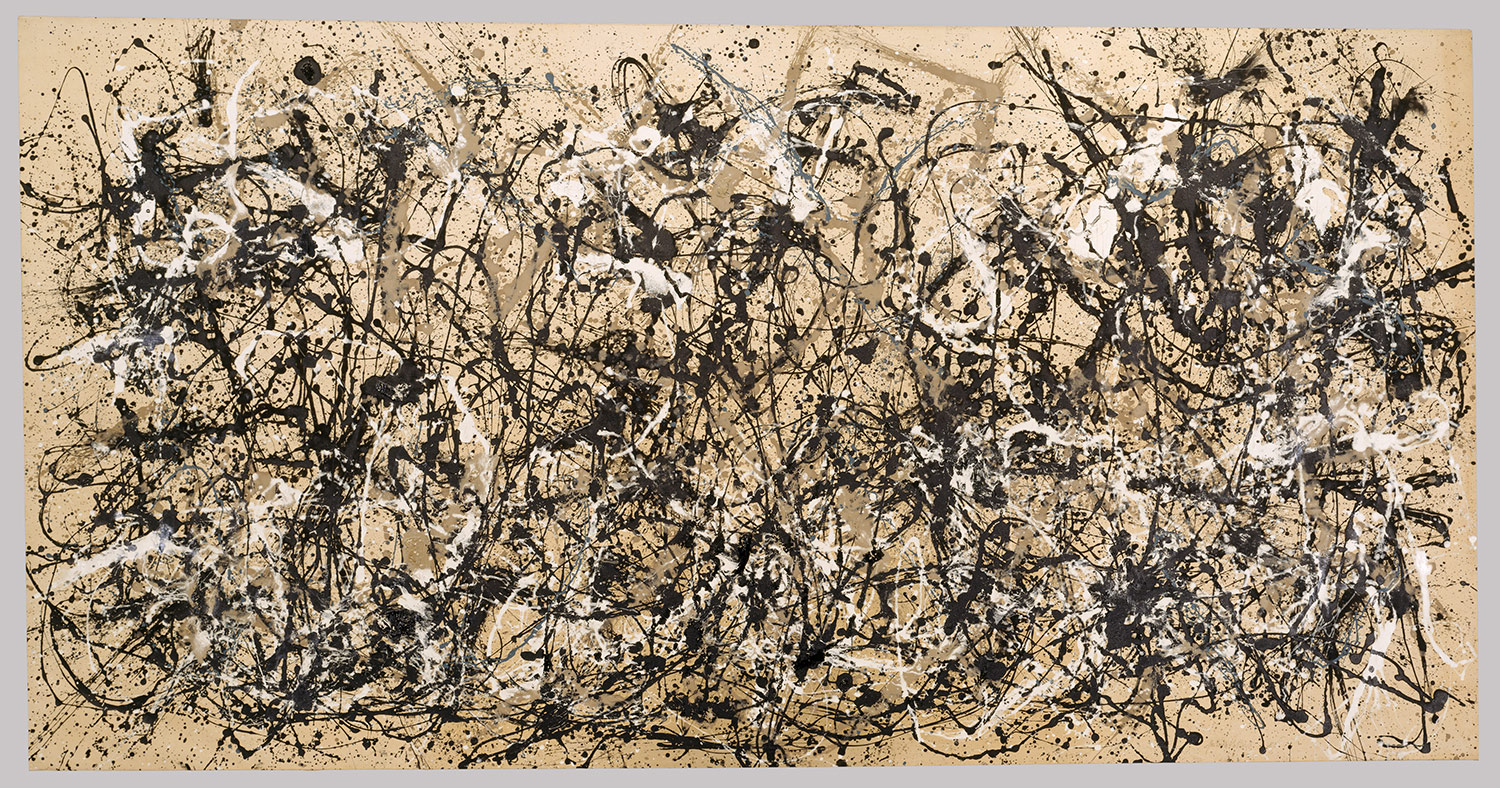
| My Pacific Isamu Noguchi The work above, My Pacific by Isamu Noguchi was the only piece in the show that was made of wood. It resonated with me as do all Noguchi pieces. He liked to use natural materials as he found them, a sentiment that I agree with. This sculpture was made from a piece of driftwood. It is one of the pieces that Noguchi made after he voluntarily spent time in a Japanese internment camp in Arizona during World War II setting up an an arts and crafts guild for the detainees. He made several of these sculptures after left the camp. I particularly like how he has preserved the nature of the driftwood so that its origins are referenced in the finished piece. I could not write a post about abstract expressionism without including a picture and comments about Jackson Pollack. I would not say that he was the main attraction of the exhibit although the room where his pictures were displayed seemed to be the room that had the most people. I went back and forth between several rooms to take several looks at many of the paintings. Every time I went through the Jackson Pollack room it was always full of people. The interesting thing about the people were their reactions to Pollack's work. Some people were simply bewildered. Some were unjustly dismissive and others would say, "I don't like it. I know what I like and I don't like this." To me, Jackson Pollack's work has an energetic vibrancy that resonates like hot jazz. I can hear the music as I stand in front of the painting soaking it all in. I do not pretend to have any expertise regarding abstract expressionism but this exhibit certainly moved my appreciation for this art ahead several steps. abstract expressionism was an important period of our artistic culture. You cannot appreciate these pictures by looking at them online or in a book, you have to see them in person. If you have not had a chance to see these pictures then go and see them. You will not regret it! |
Subscribe to:
Posts (Atom)